
TEACHING METHODS USED BY THE TEACHER
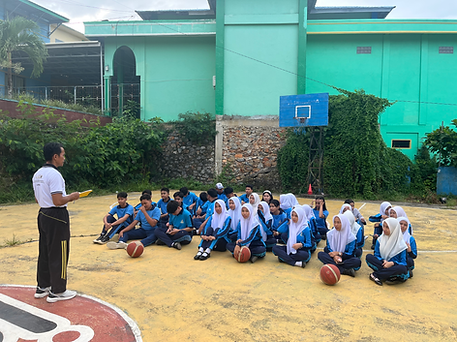
During my classroom observation, I had the opportunity to observe my coordinating teacher, Mr. Safilu, teach a PJOK class focusing on basketball. PJOK stands for Pendidikan Jasmani, Olahraga, dan Kesehatan, which translates to Physical Education, Sports, and Health in English. In terms of teaching strategies, teaching PJOK is very similar to teaching standard Physical Education classes. Mr. Safilu uses a highly effective, structured approach to guide the students. His primary strategy relies on direct instruction, where he first explains the concepts clearly, followed immediately by a physical demonstration of the specific skills. This combination helps students understand the theory before seeing it in action.

During this specific session, Mr. Safilu focused on the three fundamental skills of basketball:
-
Dribbling: Bouncing the ball correctly while maintaining control.
-
Shooting: The proper form and technique needed to score.
-
Passing: Delivering the ball accurately to a teammate.
By breaking the lesson down into direct explanations and clear demonstrations, Mr. Safilu ensured that the students could easily follow along and practice each basketball skill with confidence. This observation highlighted the importance of clear modeling in physical education.

teaching and learning materials and innovation used in the classroom
Observing the implementation of Physical Education (known as PJOK in Indonesia) at SMAN 4 highlights both interesting cultural differences and effective teaching strategies compared to the Philippine setup. While the core subject matter is quite similar to our PE curriculum back home, the scheduling structure is completely different. In the Philippines, PE classes are usually split into shorter sessions across multiple days in a week. However, in Indonesia, a specific section like 10-A meets only once a week, but they dive into the subject for a continuous three-hour period. This longer block of time initially seemed challenging, but seeing how it is structured changed my perspective on how to maximize student engagement.


Mr. Safilu manages this three-hour block perfectly by splitting the session into a seamless transition from theory to practice. He starts inside the classroom to introduce the key components of the lesson, utilizing a balanced mix of traditional and modern instructional tools. By using both the blackboard for quick notes and a projector for interactive visuals, he ensures that the students grasp the concepts clearly. Once the theoretical foundation is set, the class moves directly out to the sports field. This is where the practical integration happens, allowing the students to immediately apply what they just learned through physical execution and drills. This combined approach keeps the long session productive, engaging, and highly effective for the students.
learning resources and technology used by the teachers


Mr. Safilu demonstrates an effective approach to teaching physical education by seamlessly blending traditional and technology-based learning resources. In the classroom, he optimizes the first 45 minutes of the session by encouraging us to follow along in our textbooks while he presents dynamic PowerPoint slides using his laptop and a projector. This combination of visual aids and print media keeps the theoretical discussion highly engaging and ensures that everyone understands the day's concepts before moving to any physical execution.
Following the classroom discussion, the lesson smoothly transitions to the outdoor sports field for the practical application of the lesson. Here, Mr. Safilu gives clear, step-by-step demonstrations of the fundamental skills in basketball, specifically focusing on passing, dribbling, and shooting. To keep the drills organized and effective, he strategically sets up cones across the court to mark exact stations where we are supposed to perform each skill. This structured setup bridges the gap between classroom theory and field practice, making it much easier for us to master the mechanics of the sport in a safe and orderly environment.

The authentic assessment method used by the PE teachers at SMAN 4 emphasizes a practical and complete evaluation of what the students have truly learned. Instead of relying solely on written tests, the evaluation takes place immediately after the students have completed both the classroom discussions and the outdoor field practice. This timing ensures that the students are fully prepared and have had enough time to practice before they are officially graded on their physical execution.
To grade these performances fairly, the teachers utilize a holistic rubric during the assessment. As the students perform the full sequence of skills they have acquired throughout the unit, the teacher closely observes their movements and scores them based on their overall performance rather than just focusing on one isolated skill. This approach is highly effective because it gives a clear and realistic picture of a student’s true physical capabilities and coordination, making the entire grading process both fair and meaningful.
authentic assessment used by the teachers
